
Medically reviewed by Justin S. Lee, MD, Board-Certified Interventional Radiologist
If you are getting up several times a night to urinate, having trouble starting your stream, feeling like your bladder never fully empties, or planning your day around the nearest bathroom, an enlarged prostate may be part of the problem.
Benign prostatic hyperplasia, or BPH, is very common as men age. But common does not mean you have to simply live with the symptoms. Medications and surgical procedures are options, but there is another treatment many men still have not heard about: prostate artery embolization, or PAE.
PAE is a minimally invasive, nonsurgical treatment for an enlarged prostate that reduces blood flow to targeted areas of the gland so the prostate can shrink over time. For the right patient, that can mean better urinary flow, fewer trips to the bathroom, and relief from other symptoms caused by BPH.
Why Does an Enlarged Prostate Cause Urinary Problems?
The prostate sits around the urethra, the tube that carries urine out of the bladder. As the prostate grows, it can begin to squeeze that passageway.
At Sarasota IR Associates, Nurse Practitioner Jaime Lee often explains the process to patients with a simple visual: as the prostate enlarges around the urethra, it can make it harder for urine to flow freely. The bladder then has to work harder to push urine through the narrowed opening.
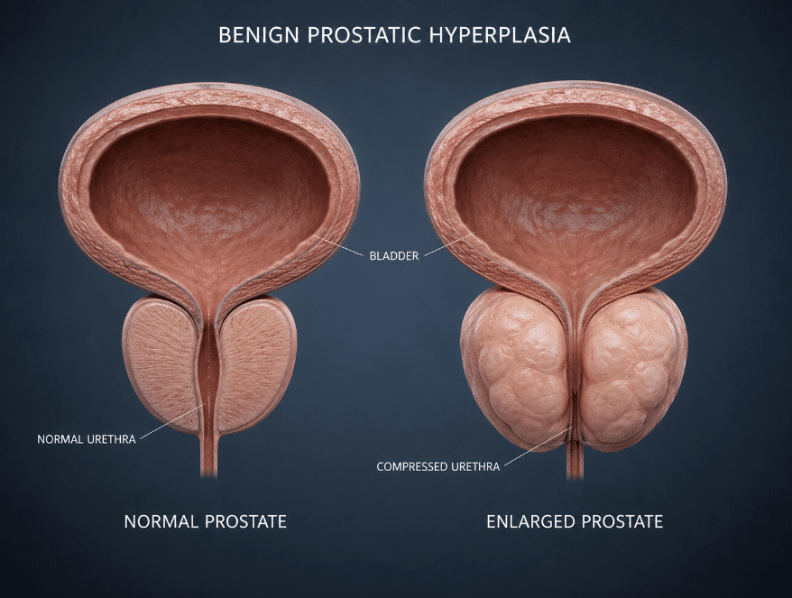
These problems are often referred to as lower urinary tract symptoms, or LUTS.
Symptoms of an enlarged prostate can include:
- Frequent urination
- Waking during the night to urinate, also called nocturia
- Difficulty starting urination
- A weak or interrupted urine stream
- Urinary urgency
- A feeling that the bladder has not completely emptied
One point that can surprise patients is that prostate size alone does not tell the whole story. Some men with a moderately enlarged prostate have significant symptoms, while others with a much larger prostate may have fewer complaints.
What matters is how the enlargement is affecting you.
What Is Prostate Artery Embolization?
Prostate artery embolization, or PAE, is a minimally invasive treatment for BPH and enlarged prostate symptoms.
PAE is performed by an interventional radiologist, a physician trained to use medical imaging to guide very small catheters through the body’s blood vessels.
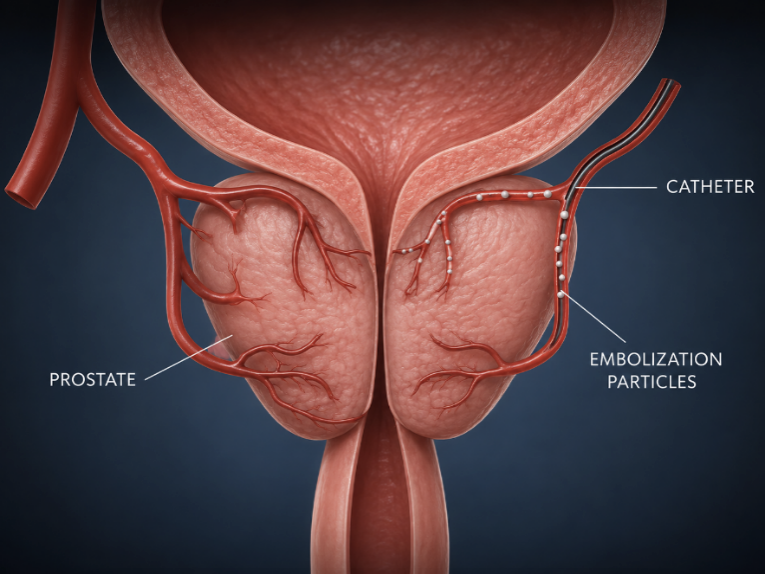
During PAE, the physician guides a tiny catheter into the arteries that supply blood to the prostate. Very small particles are then delivered through the catheter to reduce blood flow to targeted areas of the gland.
By reducing blood flow to those areas, PAE is intended to help the prostate gradually decrease in size.
Dr. Justin Lee sometimes describes the process as “pruning the tree”: reducing the prostate tissue contributing to the obstruction without surgically removing it.
What Happens During a PAE Procedure?
PAE does not require traditional open surgery.
At Sarasota IR Associates, the procedure is performed through a very small access point using catheters, wires, medical imaging, and embolic particles.
The catheter is guided through the blood vessels to the arteries supplying the prostate. Once the physician reaches the appropriate vessels, tiny particles are delivered to reduce blood flow on each side of the gland when anatomy allows.
Patients typically receive local anesthesia and sedation rather than general anesthesia.
Most patients are able to go home the same day.
How Is PAE Different From Prostate Surgery?
Traditional surgical treatments for BPH generally work by removing or destroying prostate tissue that is obstructing urine flow. Those treatments can be very effective, but different procedures come with different recovery considerations and potential side effects.
PAE approaches enlarged prostate treatment differently.
Instead of surgically removing prostate tissue, PAE works through the prostate’s blood supply. This makes it an option for some men who are looking for a nonsurgical treatment for an enlarged prostate.
PAE is not necessarily the right choice for every patient, and it is not a replacement for every type of prostate procedure. The right treatment depends on your symptoms, anatomy, medical history, previous treatments, and other individual factors.
Does PAE Affect Sexual Function?
For some patients, one of the most important reasons to ask about PAE is its potential to treat urinary symptoms while avoiding some of the sexual side effects associated with certain surgical procedures for BPH.
Individual risks and benefits vary, so sexual function and potential side effects should be part of the conversation with your physician when comparing enlarged prostate treatment options.
What Kind of Improvement Can Patients Expect After PAE?
The goal of PAE is symptom improvement, not simply reaching a specific prostate size.
In Sarasota IR Associates’ patient consultations, the team explains that the prostate may decrease in volume after treatment, but there is no single “magic number” that predicts how a particular patient will feel.
A meaningful result is improvement in the symptoms that brought you in, which may include:
- Stronger urinary flow
- Less urgency
- Better bladder emptying
- Fewer trips to the bathroom
- Fewer interruptions to sleep
- Less disruption to daily activities
The PAE procedure typically results in a 30 to 50% reduction in the volume of the prostate.
That reduction can have a meaningful impact on quality of life as the urinary symptoms that initially brought a patient to Sarasota IR Associates improve.
Individual results vary, and prostate size is only one measure of success. The larger goal is helping the patient feel and function better.
Is PAE Permanent?
PAE can provide lasting symptom relief, but it is important to remember that the prostate can continue to grow as a man ages.
That means PAE cannot guarantee that enlarged prostate symptoms will never return.
During a consultation, Dr. Lee will discuss what this may mean for each patient based on age, prostate size, symptoms, medical history, medications being used, and previous treatments or therapies.
Who Should Consider a PAE Consultation?
A PAE consultation may be worth considering if you have bothersome urinary symptoms from BPH and:
- Medications are not adequately controlling your symptoms
- Medication side effects are affecting your quality of life
- You have been told you may need a procedure for your enlarged prostate
- You want to understand treatment options for an enlarged prostate without traditional surgery
- You are concerned about the potential sexual side effects of certain prostate procedures
- You have already tried another BPH treatment and still have significant symptoms
PAE is not the right treatment for every patient.
A consultation is meant to determine if it makes sense for you and to help identify other factors that may be contributing to your urinary symptoms.
What Happens During a PAE Consultation in Sarasota?
At Sarasota IR Associates, the PAE consultation is not simply a few minutes of preparation before scheduling a procedure.
The team reviews your medical history, medications, previous treatments, urinary symptoms, and available imaging.
Patients are often shown their own images and walked through what the physician is seeing. The team also uses a standardized BPH symptom questionnaire to understand how much your urinary symptoms are affecting your life and to track improvement following treatment.
Dr. Lee and his team also consider your complete medical history and other factors to determine if the prostate alone is causing the problem or if there may be contributing issues that should also be addressed.
The goal is education, not pressure.
The purpose of the consultation is to give you the information you need to understand your symptoms and your enlarged prostate treatment options.
If PAE is appropriate and you want to move forward, the team can discuss next steps. If you need time to think about it, that is fine too.
Experience Matters With Prostate Artery Embolization
Dr. Justin Lee has been involved with PAE since the procedure’s early development.
In 2012, he traveled to Brazil to observe some of the early PAE procedures being performed and later brought that experience to Sarasota. He introduced PAE at Sarasota Memorial Hospital and trained physicians who perform the procedure there today.
Dr. Lee now performs prostate artery embolization at Sarasota IR Associates, his independent outpatient interventional radiology practice in Sarasota, Florida.
The practice focuses on minimally invasive treatment and a personal patient experience, with time devoted to helping patients understand their condition and their treatment options.

Frequently Asked Questions About PAE and Enlarged Prostate Treatment
What are common symptoms of an enlarged prostate?
Common symptoms of BPH can include frequent urination, waking repeatedly at night to urinate, urinary urgency, difficulty starting urination, a weak or interrupted stream, and feeling that your bladder has not completely emptied.
The severity of these symptoms does not always correspond directly with the size of the prostate.
Can an enlarged prostate cause frequent urination at night?
Yes. Waking during the night to urinate, known as nocturia, is one of the urinary symptoms that can occur with BPH.
As the enlarged prostate restricts urine flow, the bladder may have to work harder and urinary habits can change.
Is prostate artery embolization surgery?
PAE is a minimally invasive, nonsurgical procedure performed through the blood vessels.
Instead of surgically removing prostate tissue, an interventional radiologist delivers tiny particles into the arteries supplying targeted areas of the prostate, reducing their blood flow.
Can PAE shrink an enlarged prostate?
Yes. PAE is designed to reduce blood flow to targeted areas of the prostate so the gland can gradually decrease in size.
The procedure typically results in a 30 to 50% reduction in prostate volume, although individual results vary.
Can PAE help urinary symptoms from BPH?
The goal of PAE is to improve the urinary symptoms caused by an enlarged prostate.
For appropriate patients, improvement may include stronger urinary flow, less urgency, better bladder emptying, fewer trips to the bathroom, and fewer interruptions to sleep and daily life.
Do you go home the same day after PAE?
Patients undergoing PAE at Sarasota IR Associates go home the same day.
Patients typically receive local anesthesia and sedation rather than general anesthesia.
Does PAE affect sexual function?
PAE may offer some patients the opportunity to treat BPH symptoms while avoiding some of the sexual side effects associated with certain surgical prostate procedures.
Every treatment has potential risks and benefits, so sexual function should be discussed with your physician when comparing options.
Who is a good candidate for PAE?
PAE may be considered for men with bothersome urinary symptoms from BPH, especially when medications are not providing adequate relief, medication side effects are a problem, another treatment has not been successful, or the patient wants to understand nonsurgical options.
A medical consultation is needed to determine if PAE is appropriate for an individual patient.
You Have Options for Enlarged Prostate Treatment
Men sometimes live with enlarged prostate symptoms for years because they assume medication or surgery are their only choices.
For appropriate patients, prostate artery embolization gives men another enlarged prostate treatment option to discuss.
If BPH symptoms are interfering with your sleep, daily activities, or quality of life, the first step does not have to be deciding on a procedure.
It can simply be understanding what is happening, learning what treatment options are available, and finding out if PAE may be appropriate for you.
Sarasota IR Associates is located at 2001 Siesta Drive, Suite 100, Sarasota, Florida. To request a consultation with Dr. Justin Lee and the Sarasota IR team, visit SarasotaIR.com or call (941) 777-4723.