
Medically reviewed by Justin S. Lee, MD, Board-Certified Interventional Radiologist
If an enlarged prostate is keeping you up at night, sending you to the bathroom more often, or making it harder to empty your bladder, you may be wondering what comes next, especially if medication isn’t providing enough relief.
For many men, the thought of treating benign prostatic hyperplasia (BPH) brings up another concern: Does treating an enlarged prostate mean having surgery?
Not necessarily.
Prostate artery embolization (PAE) is a minimally invasive, nonsurgical treatment for BPH that may be an option for men who want relief from urinary symptoms without traditional prostate surgery.
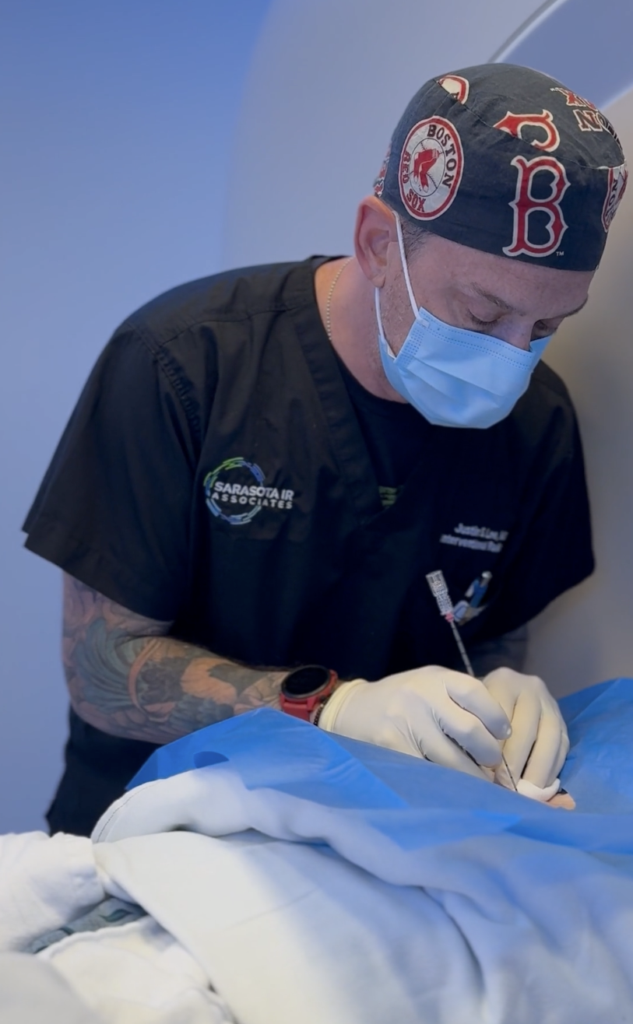
At Sarasota IR Associates, Dr. Justin Lee performs PAE as an outpatient procedure for appropriate patients with enlarged prostate symptoms.
What Is BPH?
Benign prostatic hyperplasia, or BPH, is an enlarged prostate that can cause bothersome urinary symptoms.
As the prostate enlarges, men may experience symptoms such as frequent urination, getting up multiple times during the night to use the bathroom, difficulty emptying the bladder, or changes in urinary flow.
BPH is common, but that doesn’t mean men simply have to live with the symptoms. There are several approaches to treating an enlarged prostate, and the appropriate treatment depends on the individual patient.
What Are the Treatment Options for BPH?
Many men with BPH begin by taking medication to manage their urinary symptoms. For some, medication provides enough relief. Others may continue experiencing symptoms or may want to consider another option.
Surgical procedures are also commonly used to treat an enlarged prostate.
But medication and traditional prostate surgery aren’t the only possibilities.
For some men looking for BPH treatment without surgery, prostate artery embolization provides a minimally invasive alternative.
What Is Prostate Artery Embolization?
Prostate artery embolization, or PAE, is a minimally invasive procedure used to shrink an enlarged prostate and improve urinary symptoms.
Rather than surgically removing prostate tissue, an interventional radiologist uses a small catheter to reach the arteries supplying blood to the prostate. Tiny microscopic particles are delivered through the catheter to reduce blood flow to the prostate, causing it to shrink over time.
As Dr. Lee explains:
“PAE is a nonsurgical treatment that shrinks the prostate and alleviates those urinary symptoms.”
PAE is performed at Sarasota IR Associates as an outpatient procedure, allowing patients to return home the same day.
How Is PAE Different From Traditional Prostate Surgery?
One of the established surgical treatments for an enlarged prostate is transurethral resection of the prostate, commonly called TURP.
During TURP, a urologist inserts a scope through the urethra and removes some of the prostate tissue to improve urine flow. PAE takes a different approach. Instead of removing prostate tissue, an interventional radiologist reaches the prostate through its blood supply using a small catheter.
The procedures also differ in areas such as anesthesia, catheter use and recovery.
Dr. Lee describes PAE as a treatment that can fall between medication and more invasive surgical options.
That distinction can be important for men who are still experiencing BPH symptoms but would prefer to explore a minimally invasive option before considering traditional prostate surgery.
Why Might Someone Consider PAE for BPH?
For men exploring BPH treatment without surgery, there are several reasons to discuss PAE with a physician.
PAE is minimally invasive and does not require an incision into the prostate itself. Dr. Lee performs the procedure using sedation rather than general anesthesia.
Catheter use may also be an important consideration. Dr. Lee says the large majority of his PAE patients are able to go home without a urinary catheter.
PAE may also appeal to men concerned about the potential sexual or urinary side effects associated with some surgical treatments for BPH.
Most importantly, PAE doesn’t have to be considered in isolation. It is one of several possible approaches to treating an enlarged prostate. A consultation can help determine which options are appropriate for a particular patient.
What Is Recovery Like After PAE?
At Sarasota IR Associates, the PAE procedure generally takes about an hour. Patients typically spend another one to two hours recovering at the center before returning home.
There is still a recovery period.
Dr. Lee says patients commonly experience temporary burning with urination and increased urinary frequency following PAE. These symptoms can last one to two weeks as the prostate responds to the procedure.
That doesn’t necessarily mean being sidelined for two weeks. Dr. Lee says patients are generally able to return to normal daily activities much sooner, while urinary symptoms continue to improve as the prostate shrinks.
Who May Be a Candidate for PAE?
PAE may be an option for men experiencing bothersome urinary symptoms related to an enlarged prostate, particularly those who are looking for an alternative to traditional prostate surgery.
But PAE isn’t the right treatment for every man with urinary symptoms.
A consultation gives Dr. Lee the opportunity to learn about a patient’s symptoms, medical history and previous treatments and determine if further evaluation is needed before recommending a treatment approach.
For men who are candidates, PAE can provide another option to consider between managing BPH with medication and moving forward with a more invasive surgical procedure.
Looking for BPH Treatment in Sarasota?
For men searching for BPH treatment in Sarasota, treatment isn’t only about improving urinary symptoms. It’s also about getting back to everyday life.
Sarasota is an active community. Golf, boating, fishing, the beach, restaurants, shows, travel and time with friends and family are often a big part of life here.
That’s something Dr. Lee sees in his own patients.
He says many of his patients want a treatment that addresses their enlarged prostate symptoms without unnecessarily taking them away from their normal routines.
At Sarasota IR Associates, Dr. Lee performs prostate artery embolization in an outpatient setting with a focus on minimally invasive care.
If you’re dealing with frequent trips to the bathroom, waking repeatedly during the night to urinate, changes in urinary flow or other symptoms of an enlarged prostate, PAE may be one of the treatment options worth discussing.
Schedule a consultation with Dr. Justin Lee at Sarasota IR Associates to learn whether prostate artery embolization may be appropriate for you.